You looked out at flat gray this morning and decided it was not a photo day.
I made that call for years. It cost me most of the best light I had.
Overcast light is the easiest light to shoot in, and it suits more subjects than bright sun does.
What a gray day will not give you is a dramatic sky. Point the phone at everything below the sky instead, and a dull morning turns useful.
Why flat light is good light
Cloud does one thing to sunlight. It spreads it out.
The light stops arriving from a single bright point and reaches your subject from the whole sky at once.
That removes the hard edge. No black shadow across a face, no white patch on a wet leaf where the detail has gone.
Soft light lets the camera hold the dark parts and the bright parts of a scene in the same photo.
A phone struggles most with contrast. Bright sun gives it a wider range of brightness than it can record, so it loses one end.
Gray light gives it a scene it can actually fit.
The subjects a gray day improves

Not everything gains. These do, and every one of them is on an ordinary walk.
- Color. A red leaf reads as red instead of washing out to pale orange.
- Faces. Nobody squints, and no shadow cuts across the eyes.
- Woodland. Under trees, sun makes a mess of bright patches and deep shade. Cloud evens it out.
- Water. A pond or a puddle picks up the soft sky and turns into a smooth gray mirror.
- Fine detail. Bark, moss, rust, lichen. Hard contrast swallows small texture. Flat light keeps it.
- Anything close. A flower, a gate latch, a mushroom. The closer you get, the less the sky matters.
The pattern underneath that list is worth saying plainly.
Gray light suits subjects made of color and detail, and it suits them better than sun does.
My own dullest walk is a ten minute loop past a drainage pond. On a gray morning the water goes flat and silver, and the reeds along the edge come out a color I never see at noon.
The white sky, and the two taps that fix it
One problem ruins more grey-day photos than any other. The sky comes back as a blank white shape.
That is not the phone failing. It is the phone doing what you asked it to.
A bright overcast sky is far brighter than the ground beneath it. The camera picks an average, and the sky lands past the top of what it can record.
Tap your subject rather than the sky, and the phone sets its brightness on the part you actually want.
Then drag down a little. On most phones a small sun icon or a slider appears beside the tap, and sliding it down darkens the frame.
You want the darker version. A slightly dark photo keeps its color. A bright one has already thrown that color away.
Two moves, in this order:
- Tap the subject to set the exposure on it, not on the sky.
- Drag down until the colors look right, even if the frame looks a touch dark.
A phone struggles most with contrast. Bright sun gives it a wider range of brightness than it can record, so it loses one end.
Leave the sky out of it
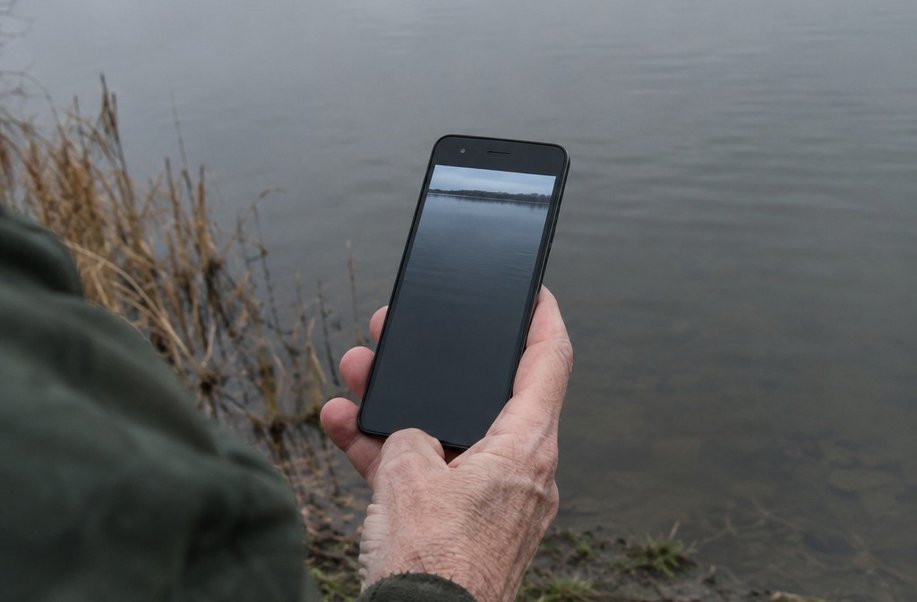
The second fix is simpler than the first. Do not put the sky in the photo at all.
A flat white sky is not a subject. It is empty space filling a third of the frame and giving nothing back.
Tilt the phone down until the horizon sits near the top of the frame, or out of the frame entirely.
Now the photo is made of the things that actually gained from the light. The path, the water, the trees, the color.
The same habit makes a dull view work at any hour. It is the part of simple composition that pays back fastest.
When a gray day is the wrong day
Flat light is not the answer to everything, and pretending otherwise would waste your morning.
Three things need a sun you do not have today:
- Long shadows. A shadow crossing the frame gives a photo its shape, and only low sun makes one.
- Glow. Backlit grass and leaves light up from inside. Cloud cannot do that.
- Texture across a surface. Light raking sideways over stone or a weathered fence needs a direction.
If any of those is what you pictured, the honest answer is to wait for the low sun and shoot golden hour instead.
Heavy cloud also gets genuinely dark under trees. The phone answers by holding the shutter open longer, and your own small movements start to show. Brace the phone against a trunk or a rail.
Your next gray morning
You do not need to wait for better weather to go out. The weather you have suits most of what is worth photographing near you.
Walk your usual route, keep the horizon high in the frame, and shoot the things you can get close to.
Tap, drag down, and come home with the colors you actually saw.
A still, cold gray morning sometimes brings mist over the water as well. That is a walk of its own.
Failing that, see what flat light does for scenic landscapes once you stop working against it.